About D2I2
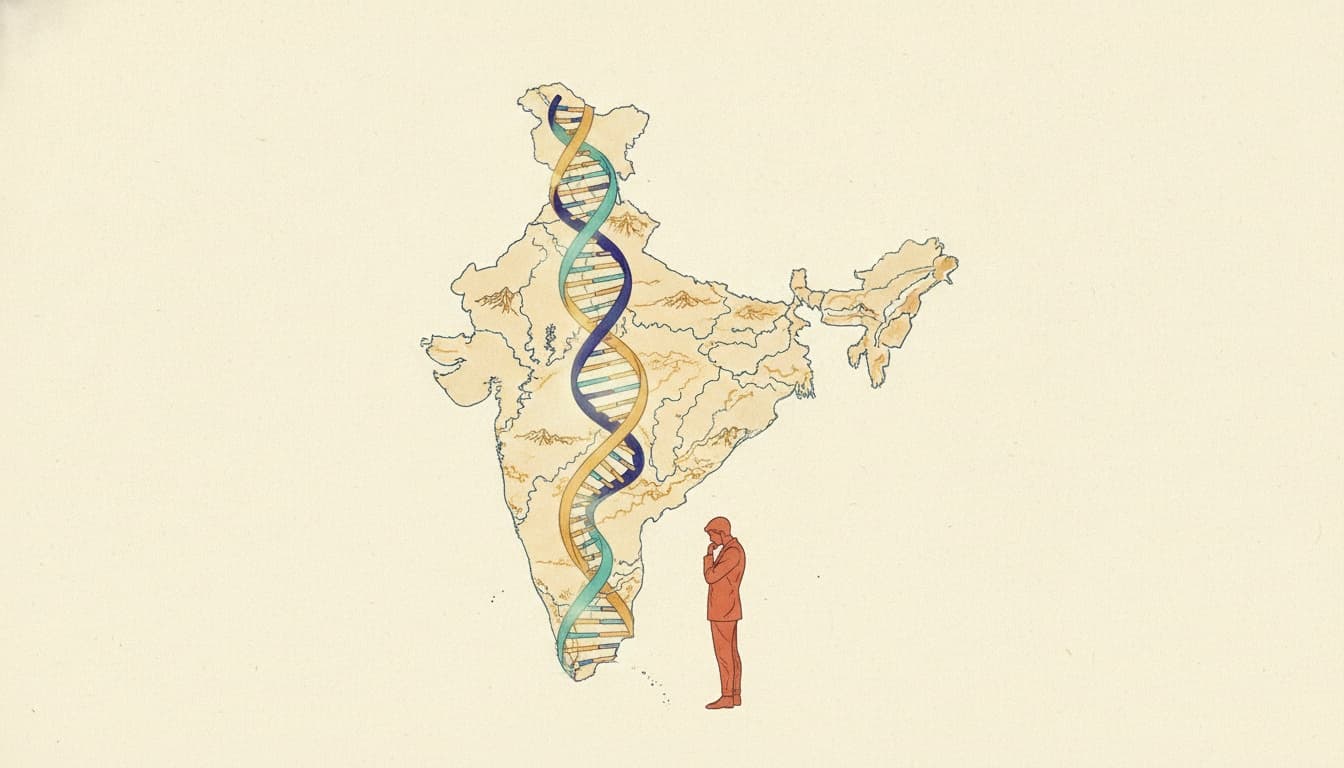
Almost everything modern medicine knows about how our genes shape disease was learned from people of European descent. They are fewer than one in five of us, yet they make up the overwhelming majority of the world’s genetic studies. South Asians — nearly a quarter of humanity — are barely represented.
That gap is not abstract. A risk score tuned on one population quietly misreads another. A gene test that looks for the mutation common in Europe can miss the one common in India. D2I2 exists to map that blind spot, disease by disease, and then to help close it.
What this is
Two things share one backend. The first is a plain-language atlas of disease across the human body, written so that a school student can understand it — every hard word is one tap from a simple definition. The second is a research map: a ranked view of where a South-Asian genomics study would matter most, grounded in real allele-frequency and risk-score data rather than opinion.
The honesty bar is fixed. Where there is no verified Indian figure for a disease, D2I2 says so plainly instead of guessing. That absence is part of what the project is trying to measure.
Who is behind it
D2I2 was started by Rahul Jindal. I’m a Senior Director, AI Innovation & Transformation at Google. I built this on my own time as a long-term personal project; it is independent of my work at Google and does not represent my employer.
I am not a geneticist by training. I began D2I2 to learn genomics by building something real and useful in it, and the project grew into something I intend to steward for years: a public resource anyone can read, and a way to fund and direct small research projects that chip away at the gaps it surfaces.
How it’s built
Everything here sits on open data — the 1000 Genomes Project, the PGS Catalog, gnomAD, AlphaMissense, and Wikipedia for the plain-language disease summaries — and the code is public. Nothing is behind a paywall, and nothing about your own health is asked for or stored on these pages.
If you’re a researcher, a clinician, a student, or someone who just wants this to exist — come say hello. This is meant to become a community project, and it gets better with more hands on it.